

Pricing psychology tips help businesses structure and present their prices in a way that increases perceived value and drives more conversions. Instead of competing on lower prices, smart businesses use psychological strategies to influence buying decisions, reduce resistance, and position their offers as the best choice. When applied correctly, pricing psychology transforms your pricing from just a number into a powerful sales tool.
What Is Pricing Psychology?
Pricing psychology is the strategic process of presenting and structuring prices in a way that positively influences how customers perceive value.
It’s not about manipulation.
It’s about understanding human behavior.
Customers rarely evaluate a price in isolation. Instead, they:
- Compare it to other options
- Associate it with perceived quality
- Measure it against expected outcomes
- Assess the level of risk involved
Your pricing isn’t just a number.
It sends a message about your confidence, positioning, and the transformation you provide.
And when structured correctly, it can dramatically increase conversions.
Why Cheap Prices Don’t Increase Sales
Many small business owners assume:
Lower price = More customers. In reality, cheap pricing often signals:
- Lower quality
- Lack of experience
- Desperation
- Reduced confidence
Customers subconsciously think:
“If it’s so cheap… what’s wrong with it?”
Instead of asking how to be the cheapest, ask how to be the most valuable. There’s a major difference. Competing on price leads to a race to the bottom. Competing on value leads to profit and long-term growth. That shift in mindset changes everything.
10 Pricing Psychology Tips to Make Your Offers Irresistible
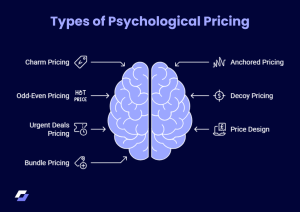
Now let’s explore practical, proven psychological pricing techniques you can implement immediately.
-
Use Price Anchoring
Price anchoring is one of the most effective pricing psychology strategies.
When you present a higher-priced option first, it sets a mental benchmark in the buyer’s mind.
For example:
Premium Package – $2000
Standard Package – $1200
Suddenly, $1200 feels reasonable.
Without the $2000 anchor, $1200 might feel expensive.
Context creates perceived value.
Always control the comparison.
-
Create a Decoy Option
Have you noticed that many businesses offer three pricing tiers?
Basic – $29
Pro – $59
Premium – $149
Most customers choose the middle option.
Why?
Because it feels like the safest and most balanced choice.
This “Good–Better–Best” strategy increases average order value while giving customers a sense of control.
It’s a simple but powerful psychological pricing technique.
-
Use Charm Pricing
$999 feels significantly cheaper than $1000.
Even though the difference is only $1.
The human brain processes numbers from left to right. That first digit heavily influences perception.
This small pricing adjustment can increase perceived affordability without reducing actual revenue.
-
Bundle for Higher Perceived Value
Instead of lowering your price, increase the value around it.
Add:
- A strategy session
- Bonus resources
- Templates
- Extended support
- Exclusive access
Keep the price the same.
Increase the value stack.
Customers compare what they receive — not just what they pay.
-
Show Value Before Revealing the Price
Never start with the price.
First communicate:
- The problem
- The pain points
- The solution
- The outcome or transformation
Only after building value should you present the investment.
When customers clearly understand the benefit, the price feels justified.
-
Use Social Proof Around Pricing
Testimonials that reference results are extremely powerful.
For example:
“We made 5x our investment in 30 days.”
This reframes the price from a cost to an investment.
Social proof reduces uncertainty — and uncertainty is one of the biggest barriers to buying.
-
Emphasize Cost Per Day
Large numbers create psychological resistance.
$1000 sounds expensive.
But $2.74 per day for a year?
That feels manageable.
Breaking down pricing into smaller time-based increments reduces mental friction and makes decisions easier.
-
Remove Risk with Guarantees
People fear losing money more than they desire gaining value.
This is known as loss aversion.
A money-back guarantee or performance guarantee reduces decision anxiety.
When risk decreases, conversions increase.
Risk reversal is one of the strongest pricing psychology tips you can implement immediately.
-
Limit Your Options
Too many choices create confusion.
And confused customers don’t buy.
Three pricing options typically convert better than six or seven.
Clarity increases confidence.
Confidence increases purchases.
Keep it simple.
-
Focus on Outcome-Based Pricing
Don’t sell hours.
Don’t sell features.
Sell outcomes.
Instead of saying:
“10 hours of consulting.”
Say:
“A system that generates 50 qualified leads per month.”
Customers don’t pay for time.
They pay for transformation.
The clearer the outcome, the stronger the perceived value.
How to Apply Pricing Psychology to Your Business
Understanding theory is important — but execution matters more.
Here’s how to apply these pricing psychology tips depending on your business model.
For Service-Based Businesses
- Structure clear tiered packages
- Anchor your highest-value offer first
- Emphasize measurable results
- Focus on transformation, not deliverables
Service pricing should communicate confidence and expertise.
For Product-Based Businesses
- Bundle complementary products
- Use charm pricing strategically
- Highlight savings visually
- Use comparison tables to anchor value
Visual presentation matters just as much as the number itself.
For Digital Marketing & Online Services
- Show ROI projections
- Include testimonials with numbers
- Position pricing as investment-based
- Break down cost over time
When customers see potential return, price resistance decreases significantly.
Common Pricing Mistakes to Avoid
Even strong offers fail when pricing is poorly structured.
Avoid these mistakes:
❌ Competing only on price
❌ Offering random or constant discounts
❌ Having no structured pricing tiers
❌ Talking about features instead of results
❌ Revealing the price too early in your messaging
If your offer feels “too expensive,” it’s often a positioning issue — not a pricing issue.
Improve how you communicate value before adjusting the number.
Final Thoughts: Price Is Emotional, Not Mathematical
Here’s the truth most business owners overlook:
Customers rarely choose the cheapest option.
They choose the option that feels:
- Safest
- Smartest
- Most valuable
When you apply these pricing psychology tips correctly, you stop racing competitors to the bottom.
You start positioning your business for profit.
And the best part?
You increase conversions without needing more traffic.
Because sometimes, the problem isn’t your marketing strategy.
It’s how your offer is structured and perceived.
Master pricing psychology — and your offers won’t just look better.
They’ll become irresistible.